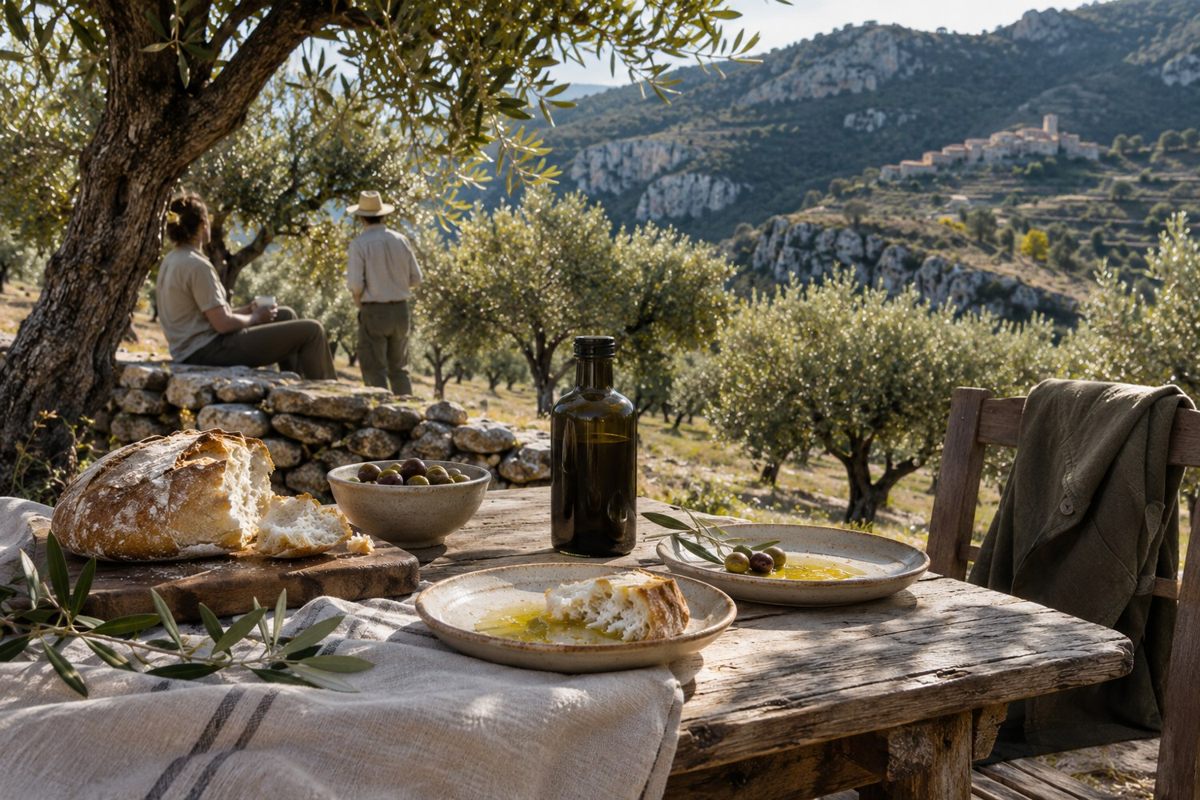
A day outdoors is not automatically a luxury experience. It can be hot, awkward and physically tiring. That is precisely why I am interested in the idea. When so much of daily work happens through screens and systems designed to remove friction, doing something real with our hands can become unusually memorable. The value may come from attention, participation and understanding rather than from being spared every inconvenience.
I am interested in small harvest experiences connected to a working agricultural project. They may appeal to people who want to understand a place through participation, while other travellers will reasonably prefer something different. The appeal, for me, begins with what a person learns by joining a process.
The difference between seeing and understanding
Looking at an olive grove can be pleasant without explaining much about olive oil. Participating in a suitable part of the work changes the questions a visitor can ask. Why is this terrace approached from one side? Why are some olives left for another day? Why does the quantity in a container not tell us directly how much oil will be available?
Those questions make the landscape more legible. A bottle that once seemed to represent only flavour and packaging becomes connected with access, weather and decisions. The oil has not chemically improved because a visitor took part. Their understanding of the product may have changed, and that distinction makes the claim more interesting and more honest.
Real work needs thoughtful hosting
Authenticity should not mean a lack of organisation. A working grove contains uneven ground, tools, changing weather and tasks that are unsuitable for an unprepared visitor. The host needs to decide which activities can be shared safely and which should remain with experienced workers. A good experience makes those boundaries clear without pretending that every part of agriculture is available for casual participation.
It also needs room for different abilities. Taking part might mean picking reachable fruit, learning how a sample is assessed or helping with an appropriate task at a suitable station. The point is understanding and contribution, not making people prove that they can endure the same workload as somebody who does it regularly.
Small groups can support a particular kind of attention
The interest in a deliberately small group is practical. A guide can answer questions, observe how people are moving and adapt the activity to the conditions. The site can remain a working place rather than becoming a backdrop for a large event. Small does not automatically mean sustainable, but it can make certain responsibilities easier to manage.
My proposed group size is twelve participants, subject to the practical arrangements of any eventual offer. Group size needs to fit safe access, supervision and the activities available on the day. An appealing phrase should not be allowed to dictate an operational arrangement that no longer suits the place.
The local community belongs in the value
Rural tourism is often discussed through the visitor's experience. It also affects the people who live and work in the area. UN Tourism emphasises the importance of inclusive planning and links between tourism and other rural activities. [1] For a small project, that means asking where the benefits go and what demands the visit creates.
Meals, accommodation, transport and local services may all form part of an experience. The useful aim is to create relationships that make sense for the people providing them, rather than assembling a picturesque programme at their expense. A beautiful day for a visitor should not depend on hidden work being undervalued elsewhere.
Leave space for the season to remain real
A harvest experience cannot promise the same conditions every time. Fruit, access and weather may require changes. If an activity has to be adapted or postponed, that is part of managing a working site responsibly. The offer should explain those possibilities rather than presenting uncertainty as a surprise after someone has booked.
This is where my idea of luxury becomes more specific. It includes enough care and clarity for people to relax into an unfamiliar process. It does not require pretending the process is perfectly controllable. Being welcomed into a genuine activity can be valuable precisely because the host explains what is happening, including the limitations.
Taking something home that is not only a product
The experience I am interested in leaves a person with a better way of noticing. They may recognise the work behind an ordinary food, ask a more informed question about its origin or understand why a modest harvest can still involve substantial effort. Those are lasting outcomes even when there is no dramatic photograph.
I would also want a participant to know what an ordinary day might feel like. Repetition, pauses and practical limits belong in that description. Someone choosing the experience should be attracted to the real activity, with enough information to judge whether it suits their interests and expectations before travelling.
I cannot predict what luxury will mean to everyone in the future. I can explain what feels valuable to me: time spent paying attention, a well hosted encounter with a working landscape and a connection between what we consume and how it comes into being. At Mas de Costa, that is the kind of experience I would like to develop carefully enough that the reality can carry the promise.
Sources
[1] UN Tourism. Rural Tourism