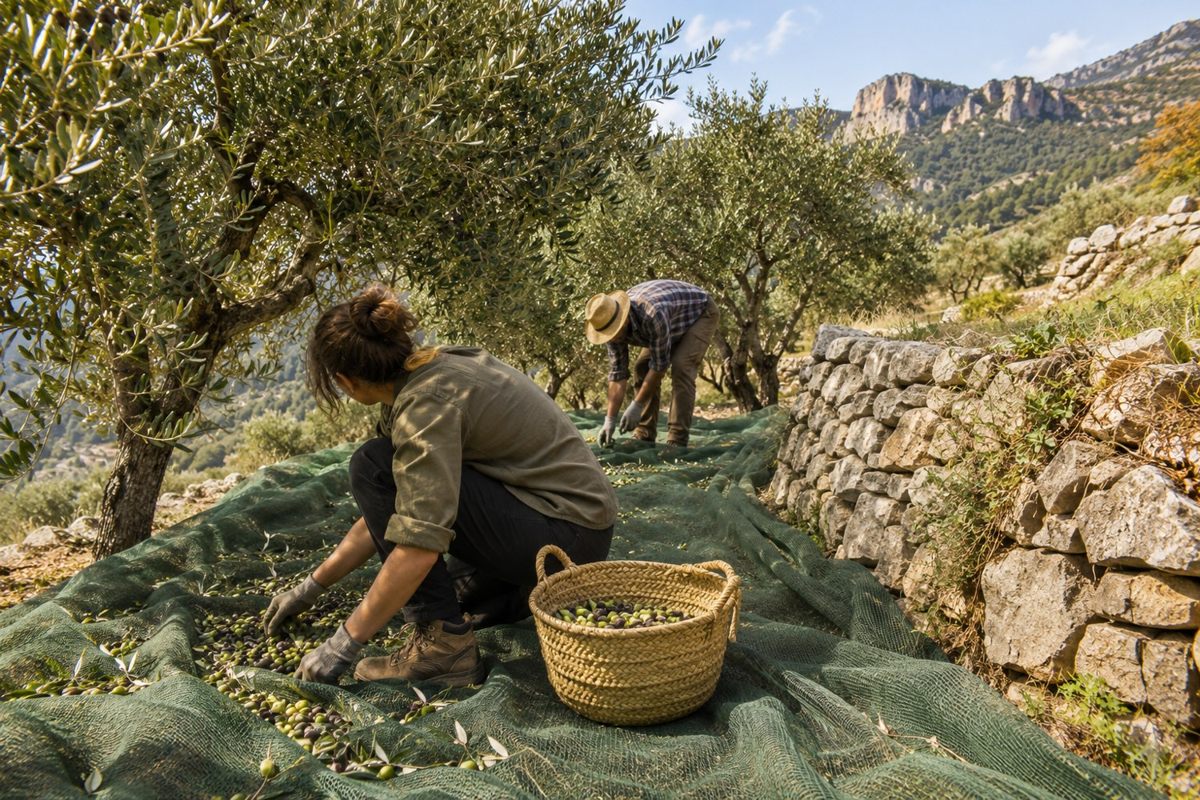
On a wide, level field, the route between a tree and a vehicle can be easy to ignore. On a narrow terrace, it becomes part of the harvest. Equipment has to arrive, people need secure footing and the olives have to leave without unnecessary damage or delay. The shape of the ground affects the whole sequence, including work that never appears in a photograph of someone picking fruit.
That is what interests me about mountain olive groves. They show how agricultural work is organised around a place rather than carried out on an interchangeable surface. The terraces in landscapes such as Els Ports and the Maestrazgo belong to a long history of making difficult land usable. Their beauty and their practical constraints come from the same physical structure.
The terrace changes the available method
Width, slope, access and tree form influence which tools and methods are appropriate. Some areas can accommodate suitable equipment; others remain more dependent on manual work or small tools. It would be inaccurate to claim that all terraced groves are harvested entirely by hand. It is equally inaccurate to assume the same machinery can be used everywhere.
The useful question is what can operate safely and effectively on a particular section. A method that works well on one terrace may create problems on the next. Decisions need to include access and the route for moving collected fruit, not only the speed at which olives can be removed from a tree.
Before the first olive falls
Preparation begins with the working area. Where can people stand? How will nets be placed and moved? Which routes need to remain clear? Where can suitable containers wait without obstructing movement? Answering those questions beforehand reduces the need to improvise while people are already concentrating on the trees.
Old stone structures also need appropriate respect. A wall edge is not automatically a safe platform, and an attractive route may not be suitable for carrying a load. Spain's heritage documentation recognises dry stone construction as specialised knowledge. [1] Harvest planning should treat the condition of the structures as a practical matter, not assume that long survival is evidence of unlimited strength.
Keep the fruit moving through a manageable chain
Harvesting speed is only one part of quality management. A container full of olives becomes another task: it needs suitable handling, a clear identity and a route to processing. If the picking team works faster than the following stages can cope, an apparently productive day can create a difficult backlog.
For a small mountain operation, it may therefore make sense to organise the day around the amount that can be moved and processed well. The practical limit can change with access, available help and mill arrangements. A realistic plan connects these parts instead of treating transport as something to solve after every container is full.
Manual work is not a quality certificate
Hand harvesting can allow selective work and close observation. It does not automatically produce excellent oil. Fruit health, damage, the interval before processing and later handling still matter. A gentle method used poorly can create problems, while appropriate mechanisation can be part of a well managed harvest.
The point is to describe the method accurately rather than use manual as a substitute for evidence. A customer may value the work involved in a terraced landscape. They also deserve a product whose quality is assessed on its own terms. The story behind the oil and the condition of the oil should support each other without becoming confused.
The workload extends beyond picking
There is a rhythm of preparation, collection, moving equipment, checking the area and leaving it ready for the next visit. Time spent between trees can be substantial. Recording only the hours when fruit is being removed gives an incomplete picture of the labour involved.
This hidden work matters when thinking about the price of a bottle or the feasibility of a restoration area. A grove that looks manageable from a distance may require more movement than expected. A useful record can help identify where a different route, a better container arrangement or a revised day's target would improve the process.
Visitors need a different kind of planning
The idea of a small harvest experience is appealing because people can understand these constraints by taking part. It also creates additional responsibilities. A host has to choose suitable activities, explain the ground and supervise people who may have little experience of working in such a setting.
Participation should fit the site and the visitor, rather than require everyone to perform the same task. The value lies in understanding how the work functions. It does not depend on making the day more demanding than it needs to be. A working grove can remain real while the experience is designed with care.
The landscape remains part of the product story
At the end of the day, olives in a container do not show every step required to collect them. Yet those steps help explain why a mountain harvest has a particular character. The walls, access and tree forms continue to influence the work, even when the final oil looks like a familiar food.
For Mas de Costa, I want that connection to remain visible without romanticising effort. Difficult work is not valuable simply because it is difficult. It becomes meaningful when it helps maintain a landscape and produce something honestly described. A mountain harvest is a practical encounter with the place, and the best account of it should allow both the beauty and the labour to be understood.
Sources
[1] Spanish Ministry of Culture. Art of dry stone construction knowledge and techniques