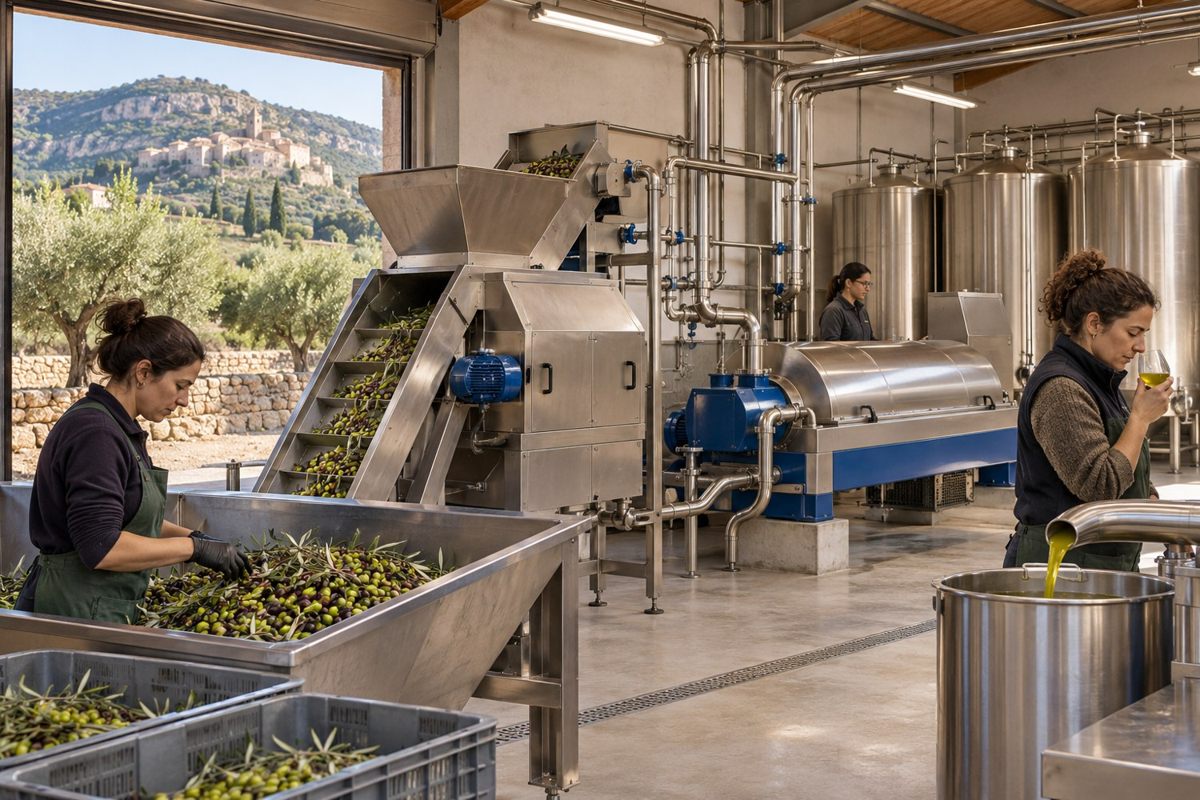
The landscape gives olive oil its beginning, but the mill changes the form of the story. Fruit enters a processing system and oil emerges through a sequence of carefully managed operations. The romantic image of a stone wheel and an old press does not describe every contemporary mill. Modern extraction commonly involves stainless steel equipment, controlled processing and centrifugal separation.
For Mas de Costa, working with a local mill makes this part of the chain essential to explain. The product should not be presented as though it moves directly from an old tree into a bottle. The people and equipment between those points help determine what the fruit becomes, and their work deserves an accurate place in the account.
Reception connects the field with processing
The mill needs to know what is arriving and how it is to be handled. The identity, condition and practical arrangements for a load belong to the same process as the machinery inside. A clearly organised harvest makes this transition easier; an unclear one can transfer its confusion to the next operator.
Cleaning and preparation remove unwanted material as appropriate to the system. The objective is not simply a visually tidy load. Material that does not belong with the olives can affect processing. The route through the mill begins with the actual fruit received, including the consequences of decisions already made in the grove.
Crushing opens the fruit
Mechanical crushing breaks the fruit into a paste from which oil can be separated. UC Davis describes crushing as one of the main stages in olive oil processing, followed by mixing and separation. [1] The equipment may differ between mills, but the general sequence is more informative than assuming that every premium oil must come from an antique press.
The paste contains more than oil. Water and solid material remain part of the mixture. Processing has to separate these components effectively while maintaining the intended product characteristics. The operation is therefore not equivalent to squeezing a ready made liquid from a fruit and doing nothing further.
Mixing is an active processing stage
Malaxation is the controlled mixing of the olive paste. It helps oil droplets come together before separation. Time, temperature and equipment choices are part of the process rather than details that disappear beneath a general claim of naturalness. [1]
This is why I prefer precise descriptions to reassuring phrases that imply no intervention at all. Olive oil can be mechanically obtained while still requiring skilled control of processing conditions. The relevant question is how the process is managed and documented, not whether the machinery looks sufficiently rustic to match the landscape on the label.
Separation does not have to mean pressing
Centrifugal equipment separates oil from the other components of the paste. Further separation and appropriate handling then prepare the oil for storage. [1] The exact configuration depends on the mill. A description of one system should not be copied automatically to another without checking what is actually used.
The wording on a label matters here. European rules reserve first cold pressing for a specified traditional hydraulic press process below 27 degrees Celsius, while cold extraction refers to specified extraction methods below that temperature. [2] These terms are not decorative synonyms. They should only be used when the actual process and supporting information justify them.
Fresh oil still needs careful handling
Extraction is a major transition, not the end of responsibility. The oil has to be received, identified and stored appropriately. Decisions about filtration, remaining moisture and solids, storage containers and subsequent bottling belong to the product's continuing care.
A dramatic photograph of oil flowing from a spout can make this point look final. In practice, it is the beginning of another set of tasks. The quality story should follow the oil beyond the moment that looks most attractive on camera, including the less visible work that protects it until it is sold and used.
Ask the mill questions that improve the account
A small brand does not need to pretend to operate every machine itself. It does need an accurate understanding of the relevant service and product information. Questions about lot handling, timing, processing descriptions and the records provided can make public communication more precise.
For Mas de Costa, this is also a matter of acknowledging local expertise. The mill is not a backdrop for the finca's story. It is a working partner in the product chain. Explaining that relationship honestly gives customers a clearer picture than a simplified narrative in which all skill and production are attributed to one place.
An accurate mill account can remain accessible without pretending to be a technical manual. Describe the relevant sequence, acknowledge where equipment differs and check optional production claims with the operator. That gives a customer a useful understanding while leaving detailed control of the process with the people qualified to carry it out.
Inside the mill, the olive becomes oil through a process that combines equipment, judgement and coordination. Understanding it does not take the romance away from the grove. It gives the romance a practical foundation, and helps ensure that the bottle tells a story the actual fruit, process and people can support.
Sources
[1] University of California Davis. Olive Oil Processing
[2] EUR Lex. Commission Delegated Regulation EU 2022 2104 consolidated text including optional cold processing terms