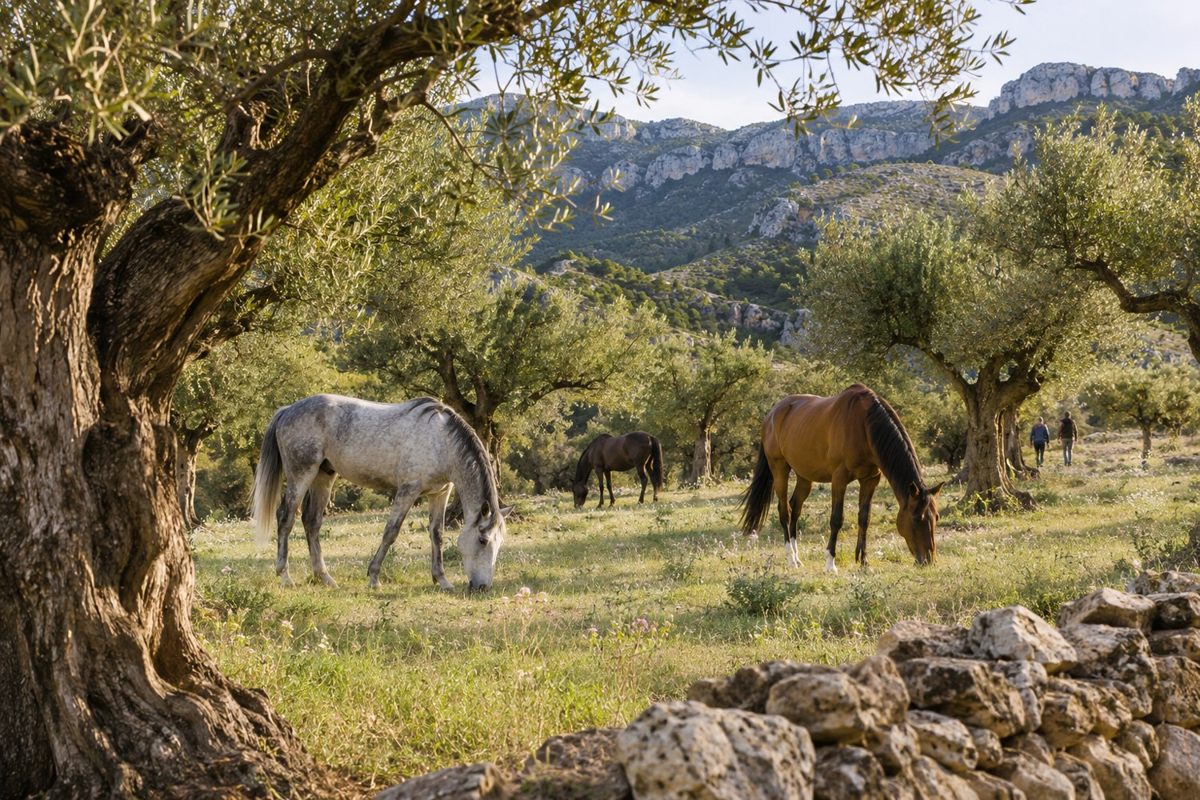
When people picture animals in regenerative agriculture, sport horses are not usually the first image that comes to mind. At Mas de Costa, they are part of the idea from the beginning. The question is not whether a horse can be placed in an olive grove. It is whether the needs of the animals, the trees and the ground can be managed together without pretending that a positive outcome follows automatically from putting them in the same space.
That distinction is central to the project. Integration sounds simple when it is described in a short post. In practice, it involves decisions about access, resting areas, vegetation, water and the condition of individual trees. A photograph can show horses among olives. It cannot tell us whether the arrangement is working over a season.
Define the outcome before using the label
Regenerative agriculture is used to describe a variety of practices and ambitions. A review of scholarly and practitioner definitions found approaches based on processes, outcomes or combinations of both. There is no single broadly accepted definition that makes the word, on its own, proof of improved soil or biodiversity. [1]
For Mas de Costa, I want the term to lead to concrete questions. Is ground cover being maintained? Are vulnerable trees protected? Can grazed areas recover? Are the animals in suitable condition? Those observations are more useful than a claim that a particular practice is regenerative in every location. The label should describe a direction of work that remains open to checking.
Grazing is a management tool rather than a free service
Horses can consume vegetation and redistribute nutrients through manure. They can also overgraze preferred areas, damage bark or repeatedly use the same routes. The result depends on the site, the number of animals, the available forage and the way access is managed. Horse pasture guidance explicitly treats soil, weather and grazing pressure as factors in what a site can support. [2]
This means an olive grove cannot simply be treated as an unlimited turnout area. Mature trunks may need protection, young trees may need exclusion and some ground may need to be rested. Access to shade and water must work for the whole group. A plan that benefits a photograph but compromises animal welfare would miss the point of integration entirely.
Rotation needs a reason to move
Rotational grazing is often presented as a sequence of dates on a diagram. A useful rotation also responds to what is happening on the ground. Plant recovery, drought, wet soil and changes in animal demand can make a fixed schedule inappropriate. Moving animals is a decision about pressure and recovery, not a guarantee that both have been managed well.
At Mas de Costa, the useful unit is therefore not only the size of an area. It is the condition in which that area is left and the condition it reaches before reuse. A smaller number of well observed areas may be more workable than a complicated layout whose recovery is never checked. The system needs to remain understandable enough to manage consistently.
The horses have their own development
Sport horses are not landscape machinery. Their social needs, nutrition, health and stage of development remain priorities. Research on young horses supports the value of appropriate exercise while also distinguishing moderate activity from excessive or unsuitable loading. It does not show that every form of difficult terrain will produce a stronger athlete. [3]
This is why I describe varied movement as an opportunity rather than a promised result. Safe ground, suitable companions and the ability to move freely can contribute to a useful environment. Steepness, poor footing or inadequate forage do not become beneficial because the setting looks natural. The horse's response remains part of the assessment.
Look for benefits and costs in the same record
If animals reduce vegetation in one area, that is an observation worth recording. It should sit alongside any signs of exposed soil, repeated trampling or damage to trees. Counting only the desirable outcome makes it impossible to improve the arrangement. A system can be successful in one respect and need adjustment in another.
The same principle applies economically. The equestrian activity may contribute to the wider business, but it also has costs and responsibilities of its own. Integration should make those relationships clearer, not conceal them. A project is easier to trust when the practical limits are visible alongside the ambition.
A working relationship between activities
I find the most interesting possibility in the connections. Olive restoration creates a reason to care for the land. Horses create daily attention to parts of that land. A carefully organised business can help fund work that takes longer to become productive. None of those relationships needs to be idealised in order to be valuable.
Integration should also be reversible. If a particular area is not suitable for the horses under current conditions, there needs to be another arrangement for them. A land management idea is easier to assess honestly when the animals' basic care does not depend on proving that the idea works everywhere.
Regeneration at Mas de Costa is therefore a question I want to keep testing. Are the connected activities helping us maintain a more functional landscape while caring properly for the animals within it? If the answer changes with the season, the management should change too. A living system deserves something more attentive than a slogan attached to a familiar practice.
Sources
[1] Newton and colleagues Frontiers in Sustainable Food Systems. What Is Regenerative Agriculture A Review of Scholar and Practitioner Definitions Based on Processes and Outcomes 2020
[2] University of Minnesota Extension. Horse pasture and site planning
[3] Research review available through PubMed Central. Training Young Horses The Science behind the Benefits 2021