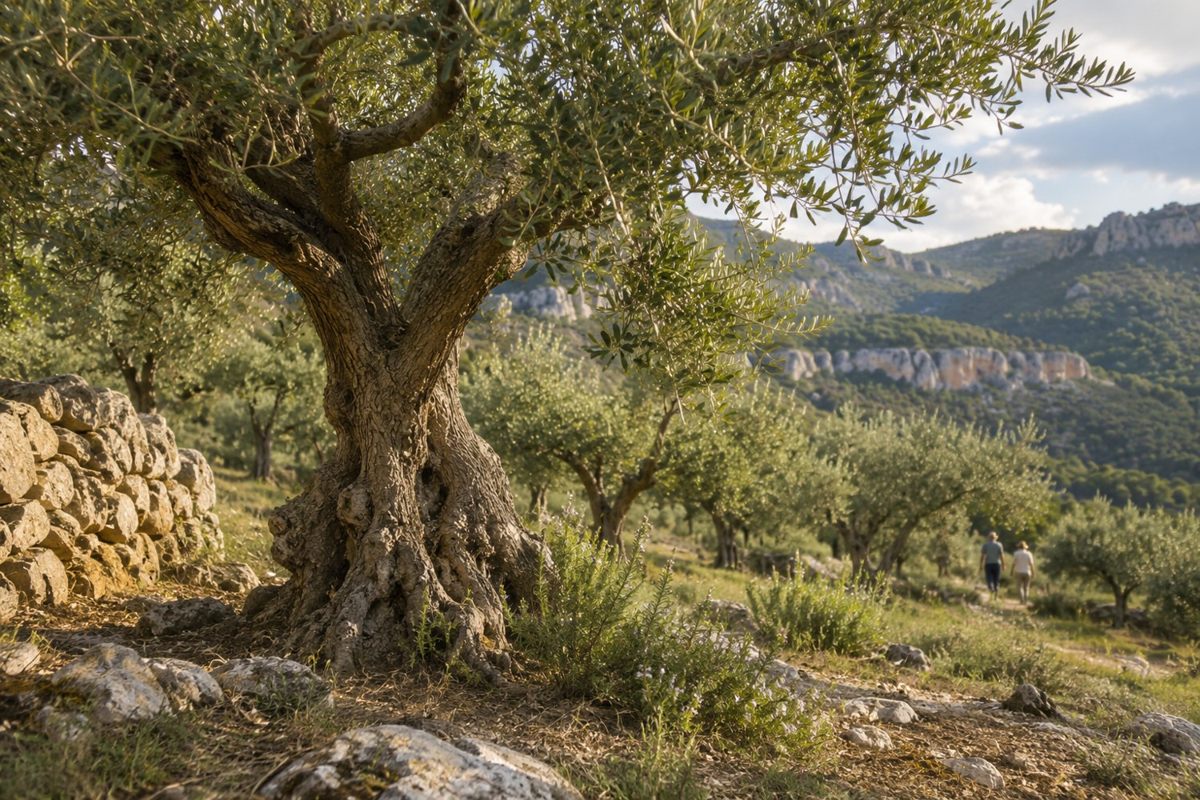
An olive tree can look remarkably composed in a dry landscape. Its leaves remain silver green while the ground beneath it becomes pale and hard. That image makes it easy to assume the tree is managing perfectly well. The assumption becomes less convincing when we ask a different question: is it merely surviving, or does it have the resources needed to develop a crop? Those are not the same achievement, and an olive grove needs us to notice the difference.
In the mountain landscapes around Mas de Costa, water is part of every agricultural decision. There is the rain that arrives, the water the soil can retain and the moisture a particular tree can reach. There is also the water needed by animals and people. Calling olives drought tolerant does not remove any of those questions. It makes careful observation more important, because visible survival can conceal a much less favourable production season.
Drought tolerance does not mean unlimited reserves
Olive trees have characteristics that help them cope with dry conditions, but their response depends on the intensity, timing and duration of stress. Research on water deficit during the period before flowering and at flowering has found reductions in fruit set and yield under the conditions studied. The useful lesson is not a universal irrigation number. It is that a tree's reproductive cycle can be affected before a harvest problem becomes obvious. [1]
That is why I would avoid describing a dry year only through the number of olives eventually collected. A small crop can be the delayed expression of earlier conditions. Looking at rainfall, flowering and fruit development together gives a more useful picture than judging the season from a single visit in autumn.
The roots are not a simple underground mirror of the tree
The familiar image of olive roots growing deep in search of survival deserves a closer look at the ground beneath each tree. Root distribution is shaped by soil depth, texture, aeration and the location of available moisture. A tree above shallow rock does not have the same underground opportunities as one in a deep, freely draining soil. Research on olive roots and irrigation therefore matters more than a general claim that every old tree reaches deep water. [2]
For someone restoring a grove, this is a useful change in perspective. The trunk is visible; the rooting environment is largely hidden. Before interpreting a weak tree as neglected, we should consider what the site allows. A terrace with little effective soil depth may need a different expectation from a sheltered pocket where soil and organic matter have accumulated.
Water arrives at different moments in the crop cycle
A wet period is not interchangeable with every other wet period. Flower development, fruit set, fruit growth and oil accumulation happen at different stages. The effect of a water shortage depends partly on which process is taking place. Studies of olive development treat fruit growth, stone hardening and oil accumulation as distinct processes rather than one continuous increase in the size of an olive. [3]
This helps explain why the same total rainfall can produce different outcomes in different years. The total is useful, but the sequence matters too. Rain that comes after a sensitive stage cannot simply rewind that stage. At the same time, later conditions still matter; a difficult spring does not make summer observation pointless.
The soil is part of the water system
When rain falls, the relevant question is how much becomes available to plants. Water may infiltrate, run downslope, collect behind a damaged structure or evaporate from exposed surfaces. On terraces, the condition of walls, outlets and ground cover influences where water goes. None of those features creates rainfall, but they affect how a limited resource moves through the site.
This is why water management should not be reduced to a choice between installing irrigation and doing nothing. There is work in maintaining safe drainage, protecting soil and understanding the paths of runoff. Interventions need to fit the site: trapping water indiscriminately can create a different problem, particularly where an old retaining structure is already under pressure.
Reading a dry grove without romanticising it
A resilient landscape is not necessarily a productive one in every season. An old olive tree can be culturally important, ecologically interesting and still produce little marketable fruit in a particular year. Those values should be described separately. Otherwise the language of resilience can become a way of overlooking stress or making production promises that the land cannot meet.
For Mas de Costa, I want drought tolerance to encourage patience rather than complacency. A lower crop should lead to questions about conditions, tree health and management, not automatically to a demand for more extraction from the same ground. Equally, restraint should not become neglect. Trees, animals and infrastructure still require attention during dry periods.
The image of the standing olive tree remains powerful. What changes is the story I attach to it. Standing is evidence of endurance, not proof of an effortless harvest. Once that distinction is understood, an olive grove becomes easier to read honestly: as a living system with limits, reserves and a season unfolding beneath the surface long before a bottle can be filled.
Sources
[1] Agricultural Water Management research article. Water relations biochemical physiological and yield responses of olive trees Arbequina and Manzanilla under drought stress during the pre flowering and flowering period 2013
[2] FAO AGRIS research record. Drip irrigation soil characteristics and the root distribution and root activity of olive trees
[3] Irrigation Science research article. Assessment of water stress impact on olive trees using an accurate determination of the endocarp development 2024