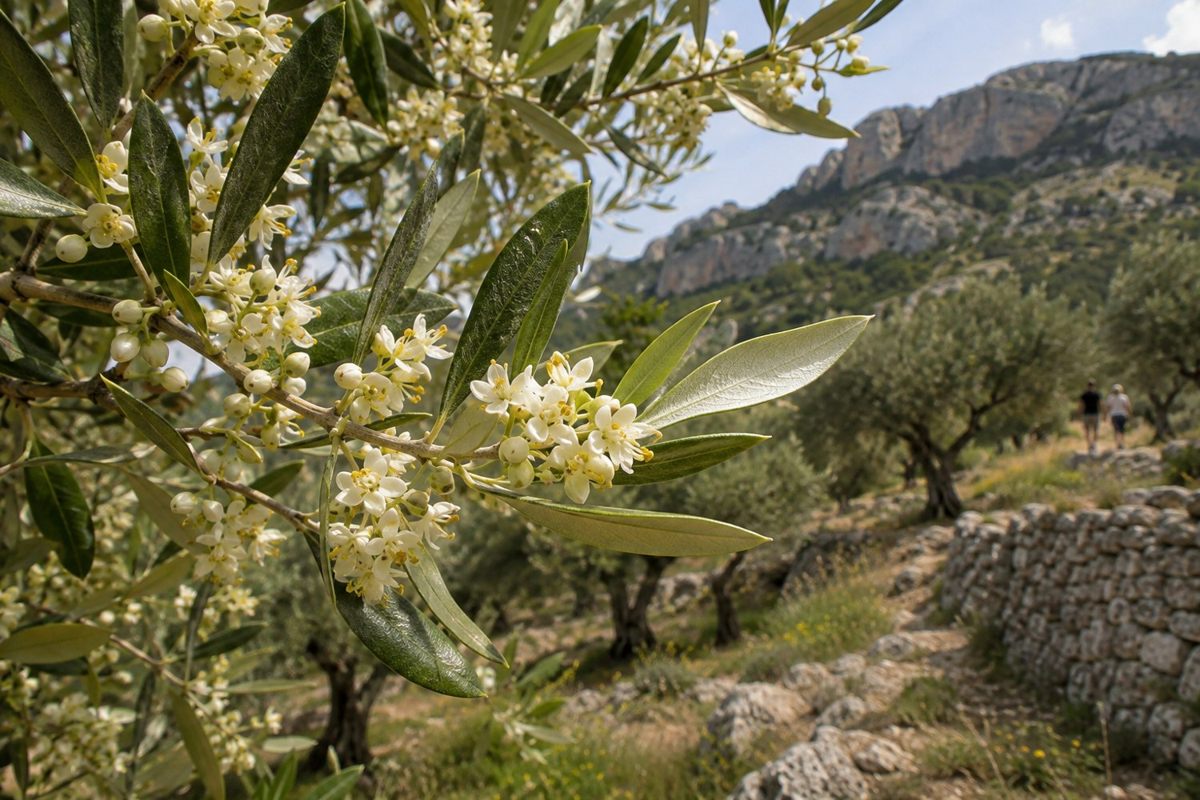
The first important signs of an olive harvest are easy to overlook. They are small, pale and briefly visible among the leaves. Olive blossom does not attract the same attention as a tree full of fruit, yet it belongs to the sequence that makes a crop possible. By the time harvest photographs appear, many earlier opportunities and limitations have already shaped what can be collected.
My original title said that October is decided in spring. It captures the importance of that period, but it is too final if read literally. Spring establishes important conditions; it does not determine every later result. Summer weather, pests, fruit health, harvest handling and milling still matter. The more interesting story is how one stage creates possibilities that the following stages can develop, reduce or lose.
Flowering is an opening rather than a guarantee
An olive flower represents potential. It is not a miniature promise of a finished olive. Flower development, pollination and fruit set are affected by the tree and its environment. Research on water deficit before and during flowering has found significant effects on fruit set and yield under the conditions investigated. That makes spring a period worth observing carefully, rather than simply waiting for visible fruit. [1]
A generous display of blossom can therefore be encouraging without providing a reliable forecast of the final crop. Counting flowers casually from a path is not the same as assessing fruit set. Some natural loss is part of the process, and the relationship between flowering and eventual production needs to be understood over time.
Trees carry more than the current season
The crop cycle does not begin from a clean slate each spring. Previous growth, crop load and management influence what a tree can do next. Olive alternate bearing is one reason a strong year should not automatically be treated as a new permanent production level. Agricultural guidance describes interactions between the current crop, vegetative growth and the potential for a later crop. [2]
For a restoration project, this encourages realistic expectations. A tree that is recovering from neglect or a demanding season may not respond immediately to improved care. A useful record follows the individual tree or a consistent group, rather than comparing unrelated photographs and expecting a clear answer after one intervention.
Watch the conditions surrounding the blossom
Temperature, water availability and the timing of weather events can influence the flowering period. The details vary with variety and site, so a useful observation includes context. When did flowering begin? Was it relatively even across the grove? Were some terraces earlier than others? Was there an obvious interruption associated with a weather event?
These notes are valuable without pretending to be a scientific experiment. Their purpose is to create a record that can be compared with later fruit development. They also make conversations with an agronomist more specific. Instead of reporting that a tree did badly, the grower can describe when the season began to diverge from expectations.
The interval between flowers and harvest is active
Once fruit has set, the work is not finished. Olives grow, the stone develops and oil accumulates through later stages. Those processes do not all happen at the same rate or respond identically to conditions. Research on olive development distinguishes fruit growth, endocarp hardening and oil accumulation, which helps explain why a single visual impression cannot describe the whole season. [3]
This also changes how we interpret a difficult spring. A reduced crop does not make later care irrelevant. Healthy fruit still needs protection and careful handling. Conversely, a promising spring does not remove the need to observe the trees during summer. The season remains open to change even after an important foundation has been laid.
A calendar can organise work without predicting nature
For Mas de Costa, a seasonal calendar is useful for remembering what to inspect and when to prepare. It is less useful when it becomes a rigid prediction. The same date can correspond to different stages in different years or on different terraces. A calendar should prompt a visit to the grove, not replace the visit.
The same principle applies to communication. It is possible to describe the excitement of flowering without announcing a bottle quantity that has not been supported by later observations. A project can invite people into the process while remaining honest about what is still uncertain. In agriculture, that honesty is part of the story rather than a defect in it.
Learning to value an early sign
There is something rewarding about noticing a stage that does not yet look like a result. Blossom reminds us that a crop is assembled through a sequence of conditions, not delivered by a single dramatic event. It also reminds us that a landscape's most important changes can be quiet.
A short flowering record can include the places observed, the date and the general conditions. It should distinguish flowers seen from fruit later retained. Returning to the same trees makes the record more useful than a collection of blossom photographs that cannot be compared with what followed.
I still like the thought behind October beginning in spring. I would now phrase it as a connection rather than a verdict. Spring helps set the possibilities; the rest of the season tests them. Understanding that relationship makes the final harvest more interesting, because the olives in a net become the visible outcome of a much longer story.
Sources
[1] Agricultural Water Management research article. Water relations biochemical physiological and yield responses of olive trees Arbequina and Manzanilla under drought stress during the pre flowering and flowering period 2013
[2] California Department of Food and Agriculture. Olive fertilization guidelines and crop development
[3] Irrigation Science research article. Assessment of water stress impact on olive trees using an accurate determination of the endocarp development 2024