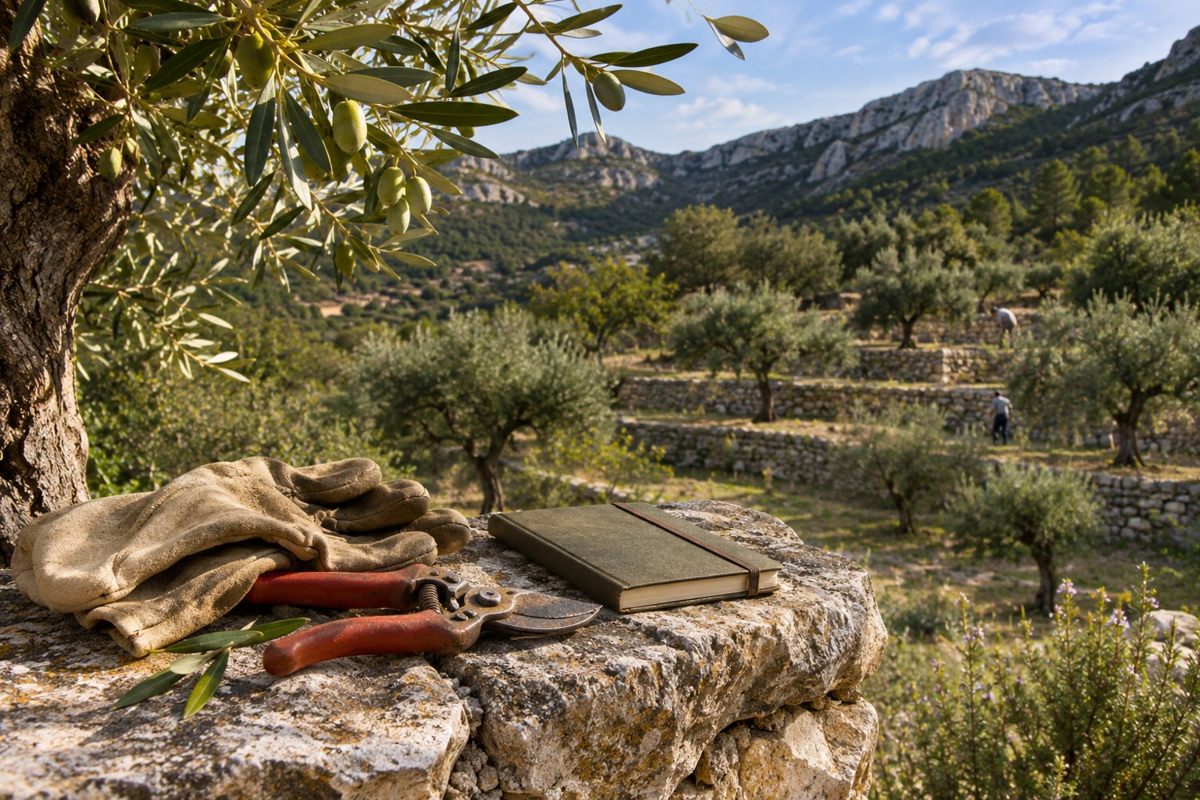
There is a difficult stage in building a rural business when the work already resembles a substantial operation but the sales do not yet support one. The land needs attention, equipment needs maintenance and the next decision cannot always wait for the next customer. At Mas de Costa, this can feel like being neither small enough to remain simple nor large enough to spread every cost comfortably. It is a useful way to understand the pressure, provided it does not become an excuse to stop examining the numbers.
Small scale is often associated with a light structure. That can be misleading. A business may produce a modest quantity while handling a complicated chain of tasks. The distinction is between how much is sold and what must be organised to make those sales possible. Those two quantities do not necessarily grow at the same pace.
Some costs exist before volume does
A basic cost structure includes expenses that change with each bottle and others that do not change in the same way. Packaging and delivery may rise with sales. Accounting arrangements, certain equipment, insurance and time spent establishing reliable processes may exist before sales reach a useful level. The exact classification depends on the business, but the principle is simple: a low production volume does not automatically mean a low cost per unit.
It is important to avoid attributing every expense to regulation. Food businesses need appropriate arrangements for safety, information and traceability, but packaging choices, access difficulties and the design of the business also affect cost. A clearer account separates necessary obligations from commercial decisions and from investments made for future activities. That makes the structure easier to improve.
Difficult terrain changes the labour calculation
On narrow terraces, the time spent reaching a tree or moving equipment can be significant. A task measured only at the tree misses the journey before and after it. Small, fragmented work areas can also interrupt the rhythm that makes larger uniform sites easier to organise. These are operational constraints, not proof that traditional agriculture is inherently inefficient.
The practical response is to record the full task. How long does preparation take? Which tools are needed? What must be carried back? Can several compatible tasks be completed in one visit? Such observations help identify real opportunities for improvement without pretending that every slope can be redesigned around a machine.
One person can hide the true cost
When the owner performs much of the work, the business may appear cheaper to operate than it really is. Unpaid time does not arrive as an invoice. It still uses a limited resource and can create a point of dependence that makes illness, fatigue or competing responsibilities difficult to absorb.
Endurance is part of building Mas de Costa. I also need to ask which tasks should be simplified, shared, outsourced or stopped. Working harder can carry a project through a demanding period, but it does not by itself demonstrate that the final model is sustainable. Owner time needs to become visible before a realistic plan for growth or stability can be made.
A useful price starts with a useful margin
Revenue is not the amount available to restore the land. A bottle sold creates costs of its own, and the money remaining must contribute to the wider structure. Looking at the selling price without considering taxes, production, fulfilment and other relevant costs can give a misleading impression of how much a small batch will finance.
That does not require publishing confidential business figures. It requires understanding them internally. A working budget can show which assumptions matter most: how many orders arrive, how much stock must be bought in advance and when suppliers need payment. Changing one of those assumptions may be more consequential than finding a small saving on a visible item.
Shared infrastructure can be a deliberate strategy
At Mas de Costa, I work with an existing local mill rather than immediately building an independent processing structure of my own. That is not a lesser version of a business. It can be a sensible division of responsibilities, provided the product's origin and the roles of the participating operators are described accurately.
European olive oil rules distinguish product categories and regulate information given to consumers. Those requirements do not mean that every brand must own every stage of production. They mean that the claims made about the oil need to be supported by the actual supply chain. [1] Understanding that difference can prevent a small project from investing in infrastructure simply because ownership sounds more impressive.
Stability is a design problem as well as a sales target
I want Mas de Costa to become a structure that can maintain the land, not a collection of obligations held together by permanent personal effort. That means checking whether each activity supports the business after its own costs and demands are included. Diversification can help, but more activities can also create more coordination work.
The encouraging part is that a clearer structure creates choices. It becomes easier to identify the next useful threshold, postpone an attractive but premature investment or explain why a product costs what it does. Small agriculture can be expensive. Understanding where the cost comes from is the first step towards making it workable rather than simply asking one person to carry more.
Sources
[1] European Commission. Olive oil categories and marketing