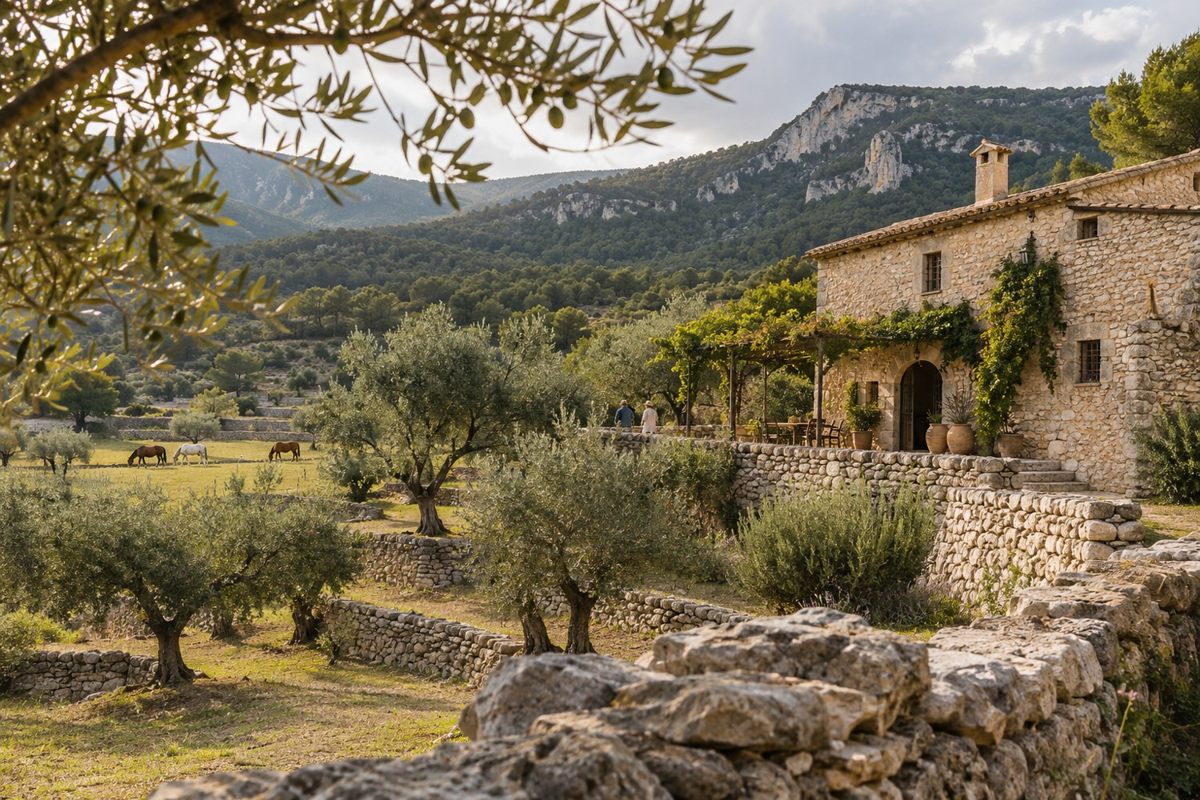
If the first thing someone sees is a bottle, it is reasonable to assume the business is mainly about oil. For me, the bottle belongs to a wider question. How can a rural landscape support useful activity again when the relationships that once maintained it have become difficult to sustain? That question leads beyond a single product, towards the connections between trees, grazing, stonework, services and the people doing the work.
Mas de Costa is an attempt to develop those connections in a contemporary way. I want to connect olive groves, horses, land management and possible future harvest experiences. That ambition is developing through work whose individual parts still need to earn their place. Keeping that distinction visible is important because a broad vision can otherwise sound more finished than the daily work actually is.
A landscape can contain several kinds of value
An olive terrace may produce fruit, retain soil and carry evidence of earlier agricultural knowledge. A path may serve visitors on one day and maintenance work on another. Horses may belong to an equestrian business while also influencing how part of the land is managed. These relationships are possible without assuming that every activity delivers an automatic environmental benefit.
The first task is to understand each function separately. What condition does the wall need to be in? What can the ground support? What do the animals require? Which activity generates income, and which needs support? Only then is it useful to describe the arrangement as an integrated system rather than a collection of appealing ideas.
The oil has a specific supply story
The oil business initially works with a local mill while the restoration of the project's own groves takes longer. This is a central part of the story. It should not disappear behind language that suggests every bottle already comes from the trees being recovered at Mas de Costa.
A product can support a landscape project without being harvested from every area pictured in its communication. The relationship needs to be explained accurately. European rules on olive oil categories and labelling make product information a responsibility, not merely a branding choice. [1] The business story should add context to that information, rather than replace it with a more emotionally satisfying origin claim.
Horses introduce daily responsibilities
The equestrian side gives the project another rhythm. Animal care cannot be postponed simply because a restoration task or a customer deadline becomes demanding. Nutrition, water, health and suitable living conditions remain priorities. Any land management role has to fit those responsibilities.
That is one reason I do not describe horses as a free solution to vegetation management. Grazing pressure and ground conditions need attention. Guidance on horse pasture management recognises the effects of soil, weather and available forage on what a site can support. [2] Integration works only if the animals remain properly cared for and the land is not treated as an unlimited resource.
Local infrastructure can make a small project possible
A rural business does not need to reproduce every service within its own boundary. Working with existing mills, suppliers and professional skills can make a modest enterprise more realistic. It can also create relationships that are valuable beyond a single transaction, provided responsibilities and expectations remain clear.
My early packaging plan combines local printing and regional processing with packaging obtained elsewhere. That combination is more informative than a blanket claim that everything is local. A credible account can explain why different choices were made and where there is still room to improve. Precision is more useful than an idealised supply map.
Visitor activities should follow the working place
Harvest experiences and rural hospitality are part of the longer term ideas. Their role should be developed around the land and the capacity to host responsibly. A grove cannot become suitable for every visitor activity simply because tourism appears in a business plan. Access, supervision, insurance and the activities available all need their own arrangements.
UN Tourism describes rural tourism as connected with agriculture, nature and rural culture, while emphasising planning and community involvement. [3] That perspective fits the intention to create an experience linked to a functioning place. It does not establish that an offer at Mas de Costa is already available, and the writing should not imply that it does.
A useful connection has to survive ordinary weeks
The real test of integration is less glamorous than a concept drawing. Can the work still be organised when weather changes? Does one activity leave enough time for another? Are costs visible, and can maintenance continue after an initial intervention? These questions reveal whether the connections are helping the business or simply adding more obligations to it.
Keeping these connections legible also helps decide what to postpone. A new activity should not be added simply because it fits the theme of rural life. It needs a practical role, suitable preparation and enough capacity that it strengthens the project instead of quietly competing with every other task.
That is why I see olive oil as an entry point into the wider project rather than a complete explanation of it. The bottle can make a landscape accessible to someone far away. The work behind it still needs to be specific, accountable and financially workable. Mas de Costa will be more than a product only if the surrounding activities become strong enough to care for the place over time.
Sources
[1] European Commission. Olive oil categories and marketing
[2] University of Minnesota Extension. Horse pasture and site planning
[3] UN Tourism. Rural Tourism